Introduction: Decoding the Legal Process
If you are researching lawsuits against the makers of Ozempic, Wegovy, Mounjaro, or Zepbound, you have almost certainly encountered the term MDL 3094 or Multidistrict Litigation. You may have also heard people refer to these cases as a "class action lawsuit."
Here's the critical distinction: While many people casually use the term "class action" to describe these cases, the GLP-1 litigation is actually an MDL—and this is not just legal semantics.
Understanding the difference between a class action and an MDL fundamentally changes:
- How you file your claim
- How much compensation you could receive
- How your individual story is told in court
- Your level of control over your case
- The timeline for resolution
This article will explain in plain English what an MDL is, how it works, where the GLP-1 litigation currently stands, and, most importantly, what you need to do to protect your rights.
The Fundamental Difference: MDL vs. Class Action
The simplest way to understand the difference is to look at how plaintiffs (the injured people) are treated and how compensation is determined.
Side-by-Side Comparison
| Feature | Class Action | Multidistrict Litigation (MDL) |
|---|---|---|
| Number of Lawsuits | One single lawsuit represents everyone | Hundreds or thousands of individual lawsuits |
| Nature of Injuries | Injuries must be nearly identical (e.g., all overcharged by $5) | Injuries are similar but vary significantly in severity (e.g., different levels of stomach paralysis) |
| Compensation Method | Total settlement pool is split equally or by broad "tiers" | Compensation is based on YOUR specific medical bills, suffering, and impact on life |
| Your Role | You are a "passive" class member | You are a named plaintiff with your own attorney |
| Case Control | Class representatives and lead attorneys make decisions | You have direct input through your own attorney |
| Opt-Out Rights | You can opt out to pursue individual claims | You maintain individual case throughout |
| Settlement Approval | Entire class must accept or reject settlement | You can accept or reject settlement independently |
| Case Specifics | Generic evidence about the class as a whole | Your specific medical records, bills, and testimony |
Why These Differences Matter to You
In a Class Action:
- You might receive a small, predetermined amount
- Your unique injuries and suffering may not be fully valued
- You have little say in strategy or settlement terms
- The focus is on efficiency over individual justice
In an MDL:
- Your compensation reflects YOUR actual damages
- A person with permanent gastroparesis requiring a feeding tube will receive more than someone with temporary symptoms
- Your attorney represents YOUR interests specifically
- Your medical evidence, lost wages, and pain and suffering are individually evaluated
Why Is the GLP-1 Case an MDL? (Not a Class Action)
The Legal Decision
In February 2024, the Judicial Panel on Multidistrict Litigation (JPML)—a special panel of federal judges—officially centralized the GLP-1 cases into:
- MDL No. 3094
- Case Name: In re: Glucagon-Like Peptide-1 Receptor Agonists (GLP-1 RAs) Products Liability Litigation
- Presiding Judge: The Honorable Karen S. Marston
- Location: United States District Court, Eastern District of Pennsylvania (Philadelphia)
Why the Court Chose an MDL Structure
The JPML determined that an MDL was appropriate because:
1. Similar Legal Questions, But Unique Injuries
Common Legal Issues (suitable for coordinated handling):
- Did Novo Nordisk and Eli Lilly know about gastroparesis and NAION risks?
- Were the drug labels adequate warnings?
- What did internal company documents reveal?
- What did clinical trials show?
- When should warnings have been updated?
Highly Individual Factors (requiring separate evaluation):
- The severity of each person's side effect (e.g., gastroparesis)
- Whether symptoms are temporary or permanent
- Specific medical expenses and treatments needed
- Impact on work, income, and quality of life
- Pre-existing conditions and other health factors
- Length of drug use and dosage
The Court's Reasoning: Medical injuries are too unique and individualized for a class action. One person might have suffered two weeks of nausea and vomiting that resolved after stopping the medication, while another might have permanent stomach paralysis requiring a feeding tube for life. These cases cannot be treated identically.
2. Efficiency Without Sacrificing Individual Justice
An MDL allows the court to:
- Consolidate pretrial proceedings (discovery, depositions, expert reports)
- Avoid duplicative litigation (drug companies don't answer the same questions 5,000 times)
- Conserve judicial resources (one judge manages common issues)
- Maintain individual case value (your specific damages are preserved)
3. Magnitude and Complexity
By early 2024, the JPML recognized:
- Hundreds of cases had already been filed across multiple federal districts
- Thousands more were anticipated
- Complex scientific and medical questions required coordinated expert testimony
- Extensive discovery from pharmaceutical companies would be needed
- Without coordination, decades of duplicative litigation would ensue
Learn the complete timeline and background of the GLP-1 litigation
How the MDL Process Works: Your Case Journey
If you decide to move forward with a claim, your case will likely follow this structured path within the MDL system. Understanding these phases helps you know what to expect.
Phase 1: Case Filing and MDL Transfer
What Happens:
Step 1: You Hire an Attorney
- You consult with a lawyer experienced in pharmaceutical litigation
- Your attorney evaluates your case for merit
- You sign a contingency fee agreement
Step 2: Your Complaint is Filed
- Your attorney files a formal lawsuit in federal court
- The complaint names you as plaintiff and the drug manufacturers as defendants
- It details your specific injuries, when you used the drug, and what damages you suffered
Step 3: Transfer to MDL Court
- Your case is transferred to the Eastern District of Pennsylvania
- Judge Marston assumes oversight of your case
- Your case receives an MDL case number
Your Role: Provide detailed information about your drug use, symptoms, and medical treatment
Timeline: 1–3 months
Phase 2: Centralized Discovery (The "Shared" Phase)
This is where the MDL structure provides tremendous efficiency and power.
What Happens:
Instead of Novo Nordisk and Eli Lilly answering the same questions in 3,000+ individual cases, they answer them once in coordinated discovery. Plaintiffs' attorneys work together through:
Plaintiffs' Steering Committee (PSC):
- A group of experienced lead attorneys appointed by Judge Marston
- They coordinate discovery strategy for all plaintiffs
- They have the resources to take on billion-dollar pharmaceutical companies
- Your individual attorney works with the PSC to advance your case
Major Discovery Activities:
Document Production:
- Internal company emails and memos
- Clinical trial data (published and unpublished)
- Adverse event reports submitted to the FDA
- Marketing materials and strategies
- Communications with the FDA
- Safety committee meeting minutes
- Expert consultant reports
Depositions:
- Corporate representatives (executives, scientists, marketing leads)
- FDA officials
- Clinical trial investigators
- Medical experts
- Key employees involved in drug development and safety monitoring
Expert Discovery:
Plaintiffs' experts provide reports on:
- Causation (how GLP-1 drugs cause gastroparesis and NAION)
- Standards of care for warnings
- Economic damages analysis
Defendants' experts respond with competing theories
The Power of Coordinated Discovery:
- Cost: Discovery costs are shared among all plaintiffs, not borne by you individually
- Expertise: Top pharmaceutical litigation experts dedicate full attention
- Smoking Guns: Centralized discovery is more likely to uncover damaging internal documents
- Pressure: Defendants face coordinated, well-funded opposition rather than piecemeal challenges
Your Role:
- Provide your medical records
- Complete interrogatories with your attorney (written questions)
- Potentially give a deposition about your specific case
- Stay in contact with your attorney
Timeline: 1–2 years (currently underway in MDL 3094)
Phase 3: Bellwether Trials (The "Test" Phase)
This is a unique and critical feature of MDLs.
What Are Bellwether Trials?
"Bellwether" is a shepherd's term for the lead sheep—the one with a bell that the flock follows. In an MDL, bellwether cases are a small group of representative cases (usually 6–12) selected to go to trial before the thousands of other cases are resolved.
Purpose of Bellwethers:
- Test the Evidence: How do juries react to the scientific evidence, internal documents, and plaintiff testimony?
- Establish Value: Jury verdicts provide a "market price" for different injury severities.
- Encourage Settlement: After a few defense losses or large verdicts, companies typically enter serious settlement negotiations.
- Reveal Strengths and Weaknesses: Both sides learn what arguments work and what doesn't.
Timeline: Bellwether trials typically begin 2–3 years after MDL formation
Phase 4: Settlement Negotiations (The "Global Resolution" Phase)
After bellwether trials establish value ranges, serious settlement negotiations typically begin.
How MDL Settlements Work:
Settlement Matrix Development: A structured system for valuing cases based on:
Injury Severity Tiers (example structure):
-
Tier 1 (Transient symptoms):
-
Nausea/vomiting resolved after stopping drug
- No hospitalization
-
No permanent effects
-
Tier 2 (Moderate gastroparesis):
-
Gastroparesis diagnosis
- Some hospitalization or ER visits
- Symptoms improved but not fully resolved
-
Able to eat with modifications
-
Tier 3 (Severe gastroparesis):
-
Confirmed gastroparesis requiring ongoing treatment
- Multiple hospitalizations
- Cannot maintain normal diet
-
Significant life impact
-
Tier 4 (Permanent disability):
-
Permanent feeding tube dependency
- Gastric stimulator implant
- Cannot work
- Total life disruption
Additional Multipliers:
- Age
- Lost income documentation
- Pre-existing conditions
- Quality of medical documentation (strong evidence = higher value)
Your Settlement Decision:
Timeline: Settlements typically begin 3–5 years after MDL formation
Phase 5: Individual Resolution (The "Your" Phase)
If You Accept Settlement:
- Your attorney submits your case for valuation
- Settlement administrator reviews medical records
- You receive a settlement offer based on the matrix
- If accepted, payment typically arrives within 60–180 days
- Your attorney deducts contingency fee and expenses
If You Reject Settlement or No Settlement is Reached:
- Your case is "remanded" back to the federal court where it was originally filed
- You can proceed to individual trial
- Your attorney represents you through trial
- This is rare but preserves your right to seek full compensation
Common Misconceptions About MDLs
Myth 1: "I'll automatically get money from the lawsuit" Reality: You must file your own case through an attorney. There is no "automatic" inclusion or payment.
Myth 2: "Everyone gets the same settlement amount" Reality: Compensation is individualized based on YOUR specific injuries, medical expenses, and life impact.
Myth 3: "Class actions are better because they're faster" Reality: MDLs often resolve in similar timeframes, but provide much better compensation for serious injuries.
Myth 4: "I can just wait and see what happens" Reality: Statutes of limitations apply. Waiting too long means you lose your rights forever.
Myth 5: "My case is too small to matter" Reality: MDLs accommodate cases of all severity levels. Even "moderate" injuries can result in substantial compensation.
Myth 6: "I need to pay a lawyer upfront" Reality: Pharmaceutical product liability cases are handled on contingency—no fee unless you win.
Frequently Asked Questions
Q1: If I join the MDL, do I have to go to Pennsylvania for court? A: No. Almost all communication happens through your attorney. You typically won't need to travel to Philadelphia unless:
- Your case is selected as a bellwether (very rare)
- A deposition is required (can often be done locally)
- Trial is necessary (only if you reject settlement)
For most plaintiffs, participation is entirely through your local attorney with no travel required.
Q2: Can I still file if I signed a waiver or consent form before taking the drug? A: Yes, very likely. Consent forms don't waive your rights if:
- The form didn't adequately warn about gastroparesis or NAION
- The manufacturer failed to provide complete information to your doctor
- The risks weren't properly disclosed
Signing a general consent form almost never prevents a product liability lawsuit.
Q3: What if I used the drug for off-label weight loss (not FDA approved indication)? A: You can still file. Off-label use doesn't eliminate manufacturer responsibility to warn about risks. In fact:
- Millions used Ozempic off-label for weight loss before Wegovy approval
- Manufacturers benefited from off-label sales
- Failure to warn applies regardless of indication
Q4: Do I need to have stopped taking the drug to file a lawsuit? A: No, but:
- Most cases involve people who stopped due to severe side effects
- If you're still using the drug without problems, you may not have damages yet
- If you're still using despite symptoms, work with your doctor first
Never stop medication without doctor guidance, especially if you're diabetic.
Q5: My symptoms improved after stopping the drug. Can I still file? A: Possibly, depending on:
- How long symptoms lasted
- How severe they were
- What medical intervention was required
- Whether you have lasting effects
Even temporary but severe gastroparesis requiring hospitalization may warrant compensation. Consult an attorney for case-specific evaluation.
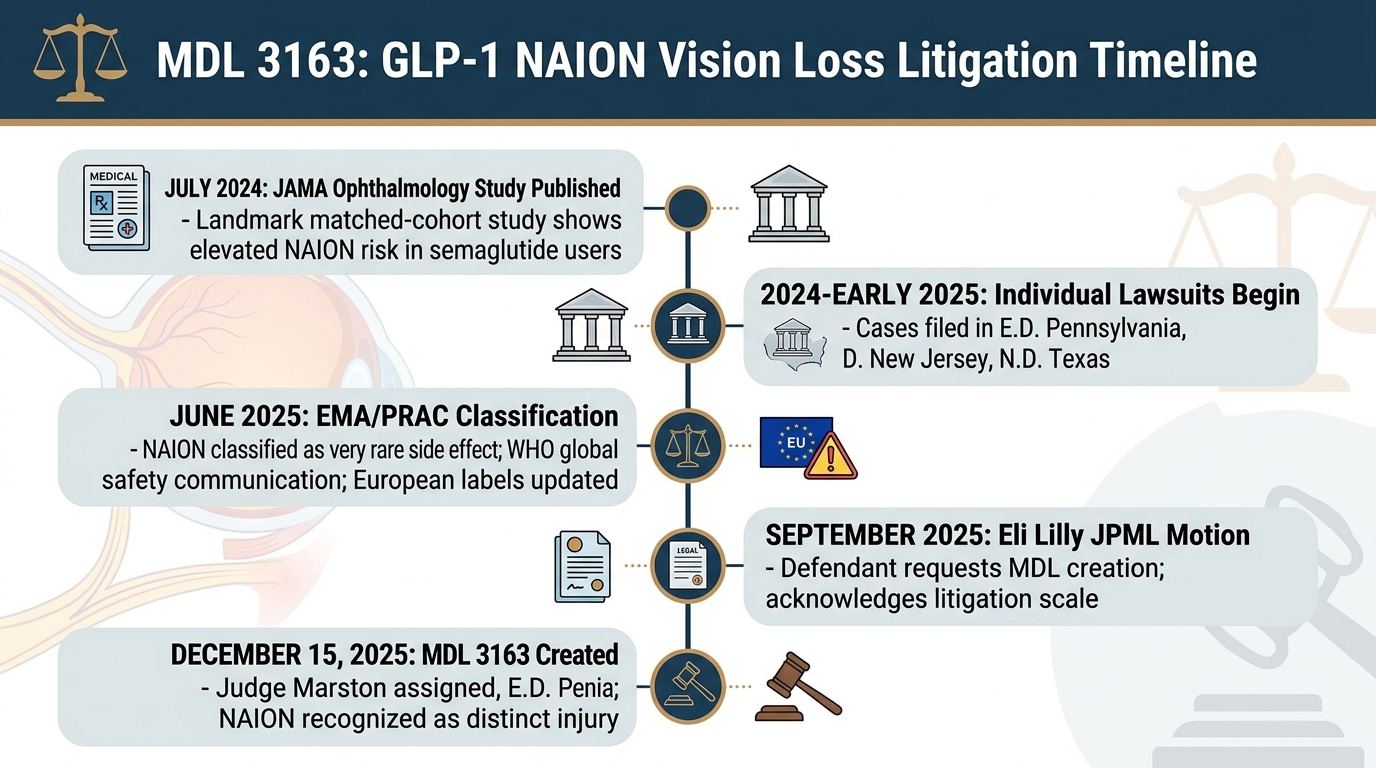
Q6: What if I have both gastroparesis AND vision loss (NAION)? A: You can participate in BOTH MDLs:
- MDL 3094 for gastroparesis/GI injuries
- MDL 3163 for NAION vision loss
Your attorney will file in both and coordinate. Total compensation would reflect both injuries.
Q7: How long do I have to file? (Statute of Limitations) A: This varies by state, but generally:
- 2–3 years from diagnosis or when you knew/should have known about the injury
- Some states have "discovery rule" extensions
Don't wait—evidence becomes harder to obtain over time. Critical: Missing the statute of limitations means you lose your rights FOREVER. Consult an attorney immediately if you're concerned about timing.
Q8: What if my doctor says my gastroparesis wasn't caused by the GLP-1 drug? A: Your doctor's opinion is just one factor. Your attorney will:
- Obtain medical records showing temporal relationship
- Hire expert witnesses to review your case
- Consider whether your doctor has bias or incomplete information
- Evaluate other evidence (timing, severity, other causes ruled out)
Don't self-reject your case based on one doctor's opinion.
Q9: Can I file if I live outside the United States? A: If you used the drug in the U.S. and developed injuries here, yes. If you're in another country:
- U.S. lawsuits may not be available
- Check if your country has separate litigation
- Consult with an attorney about jurisdiction
Q10: Do I have to testify or give a deposition? A: Possibly, but it's not as scary as it sounds:
- Depositions are usually conducted at your attorney's office or via video
- Your attorney prepares you thoroughly beforehand
- You simply answer questions truthfully about your experience
- Most plaintiffs in MDLs never give depositions (only a subset do)
If your case settles (most likely outcome), you probably won't testify.
Conclusion: Why Understanding MDLs Protects Your Rights
The distinction between an MDL and a class action is not academic—it's fundamental to protecting your legal rights and obtaining fair compensation.
Key Takeaways
Understanding MDLs Empowers You:
- You know you must take active steps to participate
- You understand your case is individual and valued specifically
- You have realistic expectations about timeline and process
- You can make informed decisions about settlement offers
- You recognize the importance of quality medical documentation
The Bottom Line:
- MDLs provide the efficiency of coordinated litigation
- While preserving the individual justice of personal representation
- Your severe injuries are valued appropriately
- You maintain control over your case outcome
Your Action Plan
If you believe you have a GLP-1 injury claim:
Do Not:
- Wait for a "settlement announcement" that will automatically include you
- Assume your case is "too small" to matter
- Delay because you're worried about costs (contingency fee = no upfront cost)
- Let the statute of limitations expire
The Stakes Are High
Gastroparesis, ileus, and NAION are life-altering injuries. Your compensation in an MDL could:
- Cover hundreds of thousands in medical expenses
- Replace lost income and earning capacity
- Provide for ongoing care and quality of life needs
- Hold pharmaceutical companies accountable for inadequate warnings
But only if you take action.
Get Started Today
Visit www.GLP1lawsuits.com to:
- Complete a free case evaluation
- Connect with experienced MDL attorneys
- Learn about the latest developments in MDL 3094 and 3163
- Access additional resources
Remember: In an MDL, no one is coming to find you. No check will arrive automatically. You must step forward, file your claim, and fight for your rights.
The pharmaceutical companies have unlimited resources and the best legal teams money can buy. The MDL levels the playing field—but only for those who participate.
Don't let your rights slip away. Act now.
Legal Disclaimer: This article provides general educational information about MDL procedures and is not legal advice. Every case is unique. Consult with a qualified attorney to evaluate your specific situation. Past MDL results do not guarantee future outcomes. Attorney advertising.
© 2025 GLP1lawsuits.com | All Rights Reserved