A brand-new federal MDL for GLP-1 NAION vision loss claims opened in December 2025. The litigation is moving fast, and the window to join is open right now.
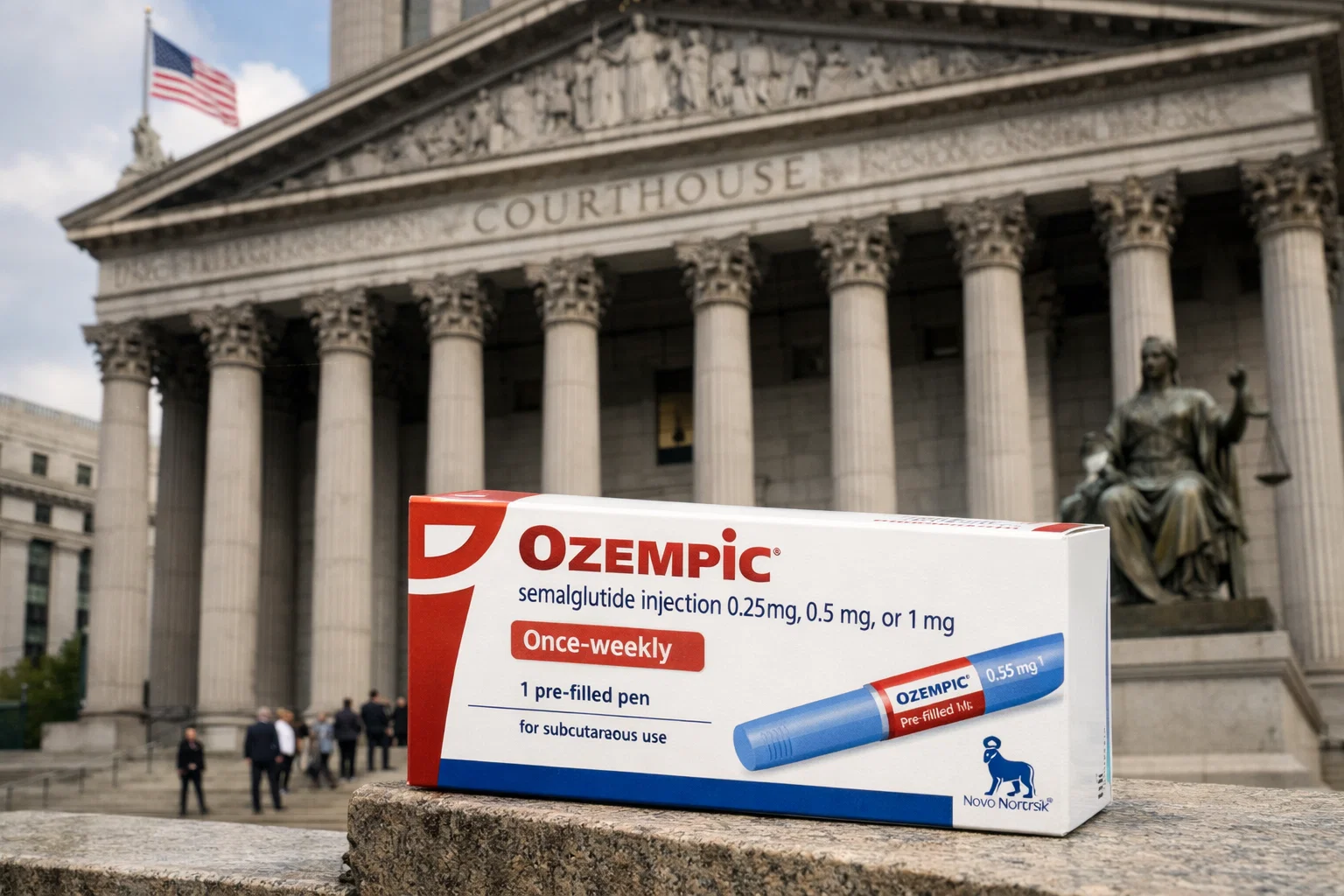
If you experienced sudden vision loss after taking Ozempic, Wegovy, Mounjaro, Zepbound, or another GLP-1 drug, the legal landscape has shifted dramatically in your favor over the past several months. A new federal multidistrict litigation, MDL No. 3163, has been created specifically for GLP-1 NAION (non-arteritic anterior ischemic optic neuropathy) vision loss claims, separate from the gastrointestinal injury litigation. Leadership counsel has been appointed, early case management orders are in place, and the docket is actively growing.
This article is your comprehensive, regularly updated guide to MDL 3163: what it is, how it got here, where it stands today, what the key legal battlegrounds are, and what you need to do to protect your rights.
📖 **Related Reading:** - For background on NAION and the GLP-1 connection, read: [Understanding the Growing Concerns Around GLP-1 Drugs and Vision Loss (NAION)](https://www.glp1lawsuits.com/blog/glp1-vision-loss-naion-risks.html) - To understand the medical condition itself, read: [What Is NAION? Understanding Non-Arteritic Anterior Ischemic Optic Neuropathy](https://www.glp1lawsuits.com/blog/what-is-naion-understanding-non-arteritic-anterior-ischemic-optic-neuropathy.html)What Is MDL 3163?
MDL No. 3163, formally titled In re: Glucagon-Like Peptide-1 Receptor Agonists (GLP-1 RAs) Products Liability Litigation (NAION), is a federal multidistrict litigation created by the U.S. Judicial Panel on Multidistrict Litigation (JPML) to centralize all federal lawsuits alleging that GLP-1 receptor agonist drugs caused NAION and related permanent vision loss.
The MDL is assigned to Judge Karen S. Marston in the U.S. District Court for the Eastern District of Pennsylvania, the same judge overseeing the gastrointestinal injury MDL (No. 3094), allowing coordinated pretrial management while keeping the two litigations procedurally separate.
What Is an MDL and Why Does It Matter?
A multidistrict litigation (MDL) is a federal procedural device that consolidates similar cases from courts across the country into a single federal court for pretrial proceedings, including discovery, expert witness hearings (Daubert), and bellwether trials. MDLs serve several important purposes:
- Efficiency: All plaintiffs benefit from shared discovery, meaning that documents, depositions, and evidence obtained from Novo Nordisk and Eli Lilly benefit every plaintiff in the MDL, not just those who filed first
- Consistency: A single judge manages pretrial motions, setting uniform rules on key legal questions
- Leverage: Centralizing thousands of claims creates leverage in global settlement negotiations
- Individual claims preserved: Joining the MDL does not eliminate your individual case — each plaintiff retains their own claim, and cases can be returned to their home district for trial if no settlement is reached
MDL 3163: Timeline of Key Events
Pre-MDL: How the NAION Litigation Began
| Date | Event | Significance |
|---|---|---|
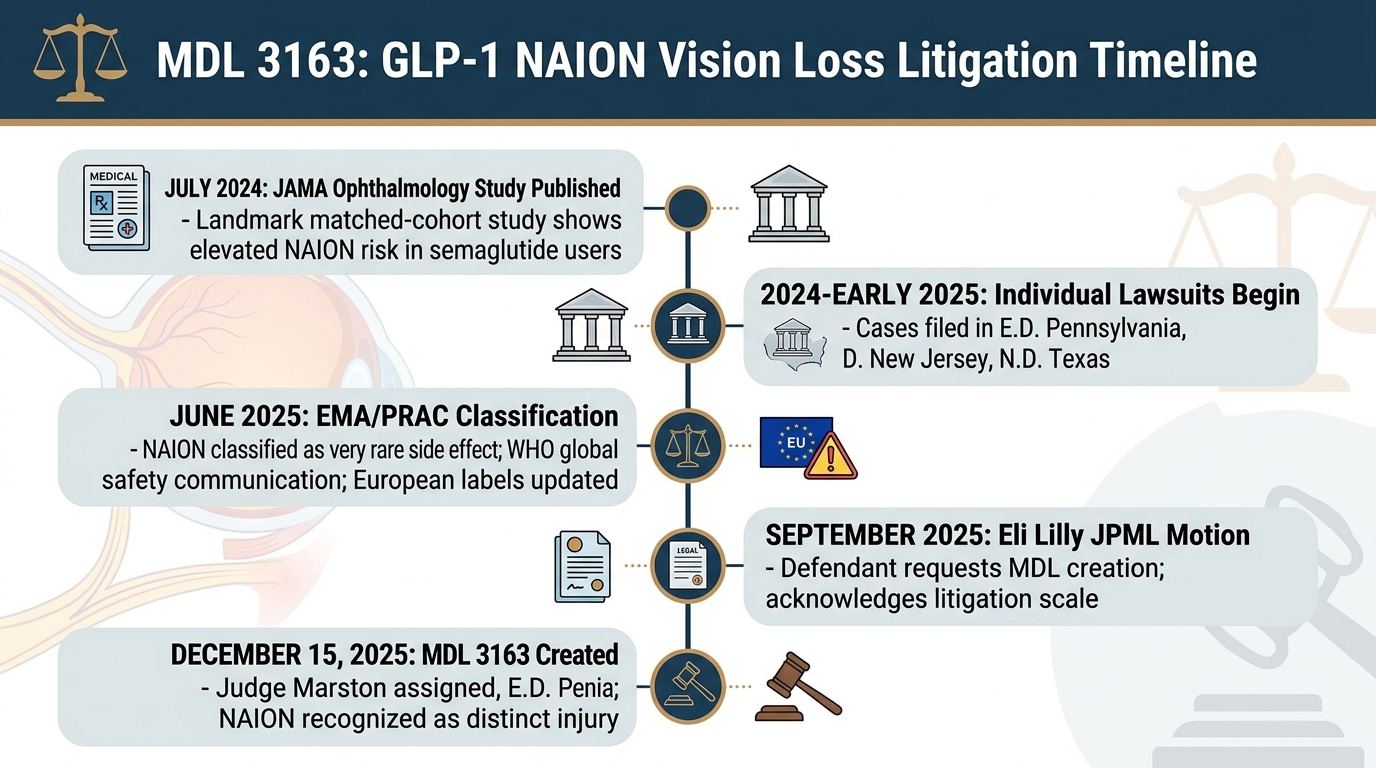
| July 2024 | JAMA Ophthalmology publishes landmark matched-cohort study finding significantly elevated NAION risk in semaglutide users vs. non-GLP-1 antidiabetic medication users | Scientific catalyst for litigation; first major peer-reviewed evidence of link |
| 2024–early 2025 | Individual NAION lawsuits against Novo Nordisk and Eli Lilly begin filing in federal courts across the country | Cases primarily filed in Eastern District of Pennsylvania, District of New Jersey, and Northern District of Texas |
| June 2025 | European Medicines Agency (EMA) / PRAC formally classifies NAION as a "very rare" side effect of semaglutide; WHO issues global safety communication | European labels updated to include NAION warning; creates regulatory gap with U.S. |
| September 2025 | Eli Lilly files a motion with the JPML requesting creation of a new MDL or consolidation of NAION cases into MDL 3094 | Defendant acknowledges litigation scale requires centralization |
| December 15, 2025 | JPML creates MDL No. 3163, a dedicated NAION MDL assigned to Judge Marston in the Eastern District of Pennsylvania | Formal recognition of NAION as distinct injury category; litigation centralized |
| December 23, 2025 | Case Management Order No. 1 (Initial Case Management Conference) and CMO No. 2 (Pro Hac Vice Admission Procedures) issued | MDL's first procedural orders; litigation formally begins |
| December 2025 | Approximately 70+ NAION lawsuits total: ~30 in federal court (now transferred to MDL 3163) and ~40 in state courts | Initial case volume establishes MDL viability |
| February 2026 | 37 pending cases in MDL 3163; docket growing as new cases are filed and transferred | Active growth phase; new filings weekly |
| February 23, 2026 | Judge Marston issues leadership appointment order | Plaintiffs' Executive Committee structure established |
| March 2026 | Additional individual lawsuits filed, including Robert J. Stottlemire v. Novo Nordisk Inc. (E.D. Pa.), alleging NAION onset after Ozempic use | Complaints cite reports of optic ischemic neuropathy linked to GLP-1 drugs as far back as 2012 |
The JPML Transfer Order: Why a Separate NAION MDL?
The JPML’s December 15, 2025 Transfer Order is an important document for understanding the strength of the NAION litigation. The JPML made several critical findings:
Common Questions of Fact Justify Centralization
The JPML found that NAION cases share common questions of fact regarding:
- The development, manufacture, testing, and regulatory history of GLP-1 drugs
- The promotion and labeling of these products, specifically the failure to warn about NAION risk
- The scientific evidence linking GLP-1 drugs to NAION causation
- Defendants' knowledge of the NAION risk and their response to accumulating safety signals
The Panel found these common questions sufficient to warrant centralization and coordinated pretrial proceedings.
Why NAION Gets Its Own MDL, Not Just a Track in MDL 3094
Eli Lilly had argued that NAION cases should be consolidated into the existing GI MDL 3094. The JPML rejected this approach for three reasons:
- NAION involves distinct medical and scientific issues, ophthalmology and neuro-ophthalmology rather than gastroenterology; optic nerve physiology rather than gastric motility; different experts, different causation theories, and different damages profiles
- Separate MDLs make case tracking cleaner and allow the transferee judge to determine the appropriate level of coordination herself
- Precedent: The JPML cited In re Taxotere (Docetaxel) Eye Injury Products Liability Litigation, where a separate MDL was created for eye injuries caused by the same chemotherapy drug already in an MDL for hair loss, a structural parallel to the GLP-1 situation
The JPML’s formal recognition that NAION is a distinct and serious injury category is significant not only procedurally but as an implicit validation of the seriousness of vision loss claims.
MDL 3163 Status: Where Things Stand in March 2026
Case Count and Composition
- ~37 pending cases in MDL 3163 as of February 2026, with new cases being filed weekly
- An additional ~40+ NAION cases in state courts, primarily in New Jersey, that are not currently part of the federal MDL but may be subject to coordination
- Defendants: Novo Nordisk (Ozempic, Wegovy, Rybelsus) and Eli Lilly (Mounjaro, Zepbound, Trulicity)
- Drugs covered: All GLP-1 receptor agonists, both semaglutide-based and tirzepatide-based products
- Core allegations across all complaints: failure to warn prescribers and patients about NAION risk; some complaints also allege design defect and breach of warranties
Leadership Structure
Plaintiffs’ leadership in MDL 3163 is now taking shape following Judge Marston’s February 23, 2026 appointment order:
- Co-Chair, Plaintiffs’ Executive Committee
- Federal-State Court Liaison
- Additional Plaintiffs’ Executive Committee members and Plaintiffs’ Steering Committee members appointed or pending appointment
Leadership counsel in MDL-level pharmaceutical litigation play a critical role: they coordinate discovery demands, take key depositions of defendant executives and scientists, retain and prepare general-causation expert witnesses, and negotiate any global settlement framework. Strong, experienced leadership is essential to maximizing outcomes for all plaintiffs.
Case Management Orders
As of early March 2026, Judge Marston has issued:
- CMO No. 1 (December 23, 2025): Initial case management conference procedures
- CMO No. 2 (December 23, 2025): Pro hac vice admission procedures for out-of-state attorneys
- CMO No. 3 (January 15, 2026): Streamlined docket
- Further CMOs covering discovery schedules, fact sheets, protective orders, and expert disclosure timelines are expected in the coming months as the MDL matures
The Central Legal Battle: Failure to Warn
Why Failure to Warn Is the Dominant Theory
The NAION MDL leads with failure to warn, the one theory that survives federal preemption for branded pharmaceutical products under the U.S. Supreme Court’s decision in Wyeth v. Levine (2009).
Under federal law, branded drug manufacturers like Novo Nordisk and Eli Lilly can unilaterally update their drug labels to strengthen warnings without prior FDA approval, using the FDA’s “Changes Being Effected” (CBE) regulation. Because they could have updated the label to warn about NAION at any time once they knew of the risk, they cannot claim federal law prevented them from doing so, and failure-to-warn claims are therefore not preempted.
What Plaintiffs Must Prove
To succeed on a failure-to-warn claim in the NAION MDL, plaintiffs generally must establish:
- General causation: GLP-1 drugs as a class can cause NAION, supported by the JAMA Ophthalmology cohort study (16,827 patients), the JAMA Network Open target-trial emulation (~1.5 million patients), EMA/WHO safety communications, and other published evidence
- Specific causation: This plaintiff’s NAION was caused by their GLP-1 drug, linked through temporal onset, dose, absence of other explanations, and expert opinion
- Inadequate warning: The GLP-1 drug label did not adequately warn prescribers or patients about NAION risk at the time of the plaintiff’s injury
- Causation of harm: If an adequate warning had been given, either the prescribing physician would not have prescribed the drug, or the patient would not have taken it (the learned intermediary doctrine)
- Damages: The plaintiff suffered quantifiable harm, permanent vision loss, medical costs, lost wages, pain and suffering
The FDA Warning Gap: A Critical Plaintiff Advantage
One of the strongest factual themes in the NAION MDL is the regulatory gap between European and American label warnings:
- June 2025: EMA and WHO formally recognized NAION as a “very rare” side effect of semaglutide; European labels of Ozempic, Wegovy, and Rybelsus updated to include NAION warnings
- As of March 2026: The FDA has NOT required or approved a NAION warning on GLP-1 drug labels in the United States
This gap is powerful evidence for plaintiffs. It demonstrates that:
- Regulators with access to the same global pharmacovigilance data concluded the NAION risk was real and required a warning
- U.S. patients were denied a warning that European patients received
- Manufacturers knew or should have known about the risk and had the regulatory tools to act
Additionally, at least one complaint has cited internal documentation suggesting that reports of optic ischemic neuropathy associated with GLP-1 drugs existed as far back as 2012, well before the JAMA studies and the FDA/EMA review. If confirmed through discovery, this would significantly advance the knowledge/concealment narrative central to pharmaceutical litigation.
Design Defect Claims: Status in MDL 3163
Design defect claims in the NAION MDL are still alive at the pleading stage. Defendants will almost certainly move to dismiss these claims early in MDL 3163, citing the same Bartlett/Pliva preemption framework. Whether the NAION MDL court follows the GI MDL’s ruling, or whether plaintiffs can distinguish their NAION claims, will be one of the first major legal battles in the MDL.
What Happens Next: The Litigation Roadmap
MDL 3163 is in its earliest stages, which is both an opportunity and a reason to act without delay. Here is a typical MDL litigation roadmap and where the NAION MDL currently sits on that path:
Phase 1: Organization and Early Case Management (Current Phase: Late 2025 to Mid-2026)
- JPML creates MDL (December 2025)
- Initial Case Management Orders issued (December 2025)
- Plaintiffs’ leadership appointed (February 2026)
- In progress: Defendants’ leadership and liaison counsel designations
- In progress: Master Long Form Complaint and Short Form Complaint development
- Upcoming: Plaintiff Fact Sheets (PFS), standardized questionnaires every plaintiff must complete documenting their GLP-1 use, diagnosis, and injuries
Phase 2: Discovery (Anticipated Mid-to-Late 2026)
- Document production from Novo Nordisk and Eli Lilly: internal research, pharmacovigilance reports, labeling decisions, marketing materials
- Depositions of key company witnesses: medical affairs officers, regulatory scientists, executives who made labeling decisions
- Plaintiff and prescriber depositions
Phase 3: Expert Development and Daubert Hearings (Anticipated 2027)
- Plaintiffs retain and disclose general causation experts (ophthalmologists, epidemiologists, pharmacologists)
- Defendants challenge expert opinions under Rule 702 (Daubert)
- Court rules on admissibility, this is the critical gatekeeper ruling that will determine how many NAION cases can go forward
Phase 4: Bellwether Trials (Anticipated 2027–2028)
- Court selects a small number of representative cases for early trials
- Bellwether trial results provide real-world data on how juries react to the evidence and damages
- Results often drive global settlement negotiations
Phase 5: Global Settlement or Continued Trial (TBD)
- If bellwether trials produce plaintiff verdicts, defendants typically enter global settlement negotiations
- Settlement values are influenced by: Daubert outcomes, bellwether results, number of eligible claimants, and individual damages profiles
Key takeaway: Because MDL 3163 is in Phase 1, the most critical action window for new plaintiffs is right now, before Plaintiff Fact Sheet deadlines, before case management cutoff dates, and before any rulings narrow the eligible case pool.
State Court NAION Litigation
In addition to the federal MDL, NAION lawsuits against Novo Nordisk and Eli Lilly are proceeding in state courts, particularly in New Jersey, where both companies have significant connections and where multi-county litigation (MCL) consolidation has been sought.
What NAION Patients Need to Know About Filing a Claim
Who May Be Eligible
You may have a potential NAION MDL claim if:
- You took any GLP-1 receptor agonist, including Ozempic, Wegovy, Rybelsus (semaglutide) or Mounjaro, Zepbound, Trulicity (tirzepatide or dulaglutide)
- You developed sudden vision loss, vision changes, or were diagnosed with NAION while on or shortly after stopping a GLP-1 drug
- You have ophthalmology records documenting the diagnosis, visual field testing, OCT imaging, or other objective findings
- You are within the applicable statute of limitations for your state
The Statute of Limitations: Do Not Wait
Every state has a statute of limitations, a legal deadline for filing a personal injury or product liability claim. Most states allow 2 to 3 years from the date of injury or the date the patient knew or reasonably should have known their injury was linked to the drug.
Because many NAION events occurred in 2023, and 2024 (when GLP-1 prescriptions surged), the clock may already be running. Missing the filing deadline permanently bars an otherwise valid claim, no exceptions. Courts strictly enforce these deadlines.
What to Preserve and Document
If you believe your vision loss may be related to a GLP-1 drug, preserve and collect:
- All ophthalmology visit records from the time of vision loss, including exam findings and any diagnosis of NAION or optic neuropathy
- OCT (optical coherence tomography) imaging, retinal nerve fiber layer reports
- Visual field test (perimetry) printouts showing the pattern and severity of field loss
- Fundus photographs or fluorescein angiography results if performed
- Pharmacy records, prescription fill history for all GLP-1 medications
- Primary care or endocrinology records documenting the GLP-1 prescription, dose escalation, and duration of use
- Any records linking the timing of GLP-1 initiation or dose changes to the onset of vision symptoms
🔬 Related Reading:
Q&A: MDL 3163 and the GLP-1 NAION Lawsuits
Q1. What is MDL 3163?
MDL 3163, formally titled In re: GLP-1 Receptor Agonists Products Liability Litigation (NAION), is a new federal multidistrict litigation created by the JPML on December 15, 2025, to centralize all federal lawsuits alleging that GLP-1 drugs caused NAION vision loss. It is assigned to Judge Karen S. Marston in the Eastern District of Pennsylvania and is separate from the GI injury MDL 3094, though both are managed by the same judge.
Q2. How is MDL 3163 different from the existing GLP-1 MDL (3094)?
MDL 3094 handles gastrointestinal injury claims (gastroparesis, ileus) and is in a more mature, contested phase. MDL 3163 is a fresh docket focused exclusively on NAION vision loss, where failure-to-warn claims are clean, objective ophthalmology records support causation, and no adverse Daubert or preemption rulings have yet been entered.
Q3. Who are the defendants in MDL 3163?
The primary defendants are Novo Nordisk (manufacturer of Ozempic, Wegovy, and Rybelsus) and Eli Lilly (manufacturer of Mounjaro, Zepbound, and Trulicity). Both companies are named in NAION lawsuits alleging failure to warn about optic nerve injury risk.
Q4. Do I have to live in Pennsylvania to file a claim in MDL 3163?
No. You can file your lawsuit in any appropriate federal court, and it will be transferred to the Eastern District of Pennsylvania for MDL pretrial proceedings. Most plaintiffs’ attorneys file directly into the MDL or in a local district and request transfer. Your attorney will handle this process.
Q5. How long will MDL 3163 take to resolve?
Large pharmaceutical MDLs typically take 3–7 years from creation to global settlement or completion of bellwether trials. MDL 3163 was created in December 2025, so the litigation is in its very early stages. Early phases involve discovery and expert development; bellwether trials are likely 2–3 years away. However, if early trials produce significant plaintiff verdicts, settlement discussions can accelerate. No one can guarantee a timeline, and each case is unique.
Q6. What is a bellwether trial?
A bellwether trial is an early test trial in an MDL, using a small number of representative cases selected by the court and parties. Bellwether trials are not binding on all other plaintiffs, but they provide real-world evidence of how juries react to the evidence, defendants’ conduct, and the damages at issue. Bellwether results heavily influence whether defendants agree to global settlements and on what terms.
Q7. Is there still time to file a GLP-1 NAION claim?
For most patients, yes, but the window is not unlimited. Statutes of limitation in most states run 2–3 years from the date of injury or discovery of the link between the injury and the drug. For NAION events that occurred in 2023–2024, time may be running short in some states. Contact an attorney immediately for a free case evaluation to determine the deadline applicable to your situation.
Why Work With Us
Exclusive Focus on GLP‑1 Injuries
Our practice is dedicated entirely to GLP‑1 medication injuries, including NAION vision loss, gastroparesis, ileus, and related complications. This is not a side project or add‑on; it is the core of what we do every day.
- Deep, case‑specific knowledge of Ozempic, Wegovy, Mounjaro, Zepbound, and related medications
- Familiarity with how these drugs work, their known side‑effect profiles, and the evolving medical and legal literature around NAION
- Hands‑on experience with MDL procedures, case‑management orders, and plaintiff requirements in complex pharmaceutical litigation
Because we live in this space, we can quickly identify the strengths and weaknesses of a potential GLP‑1 claim and tailor your case strategy around the most up‑to‑date science and MDL developments.
Integrated Medical Expert Network
GLP‑1 and NAION cases are built on medicine as much as law. We work closely with a network of highly qualified specialists who understand these specific injuries:
- Board‑certified gastroenterologists and motility specialists for gastroparesis and gastric‑emptying disorders
- Pharmacologists who can explain GLP‑1 mechanisms, dosing, and causation theories in plain language for judges and juries
- Ophthalmologists and neuro‑ophthalmologists for NAION and other optic‑nerve injuries
- Life‑care planners and vocational experts who quantify future medical needs, work limitations, and long‑term costs
This multidisciplinary team helps us document what happened medically, how it connects to the drug, and what you will likely face in the future, key issues in both settlement negotiations and trial.
Proven Results in Complex Drug Litigation
Our attorneys have collectively recovered millions of dollars for clients in pharmaceutical MDLs and other complex injury cases, including claims against major drug manufacturers. While past results cannot guarantee future outcomes, our experience shows that we:
- Know how to develop cases for bellwether trials and global‑resolution talks
- Understand how to work within MDL structures while preserving your individual story and damages
- Are prepared to stand up to large pharmaceutical companies and their insurers in discovery, motion practice, and negotiation
No Upfront Costs – Ever
We represent GLP‑1 clients on a contingency‑fee basis:
- No attorney fee unless we obtain a recovery for you
- We advance the costs of experts, records, and litigation
- Free, no‑obligation initial consultation
- Clear, written fee agreement from the beginning
Comprehensive Case Management
GLP‑1 injury and NAION cases demand detailed documentation. We take on the heavy lifting:
- Collecting and organizing medical records, pharmacy data, imaging, and diagnostic test results
- Coordinating with your treating doctors and consulting specialists
- Preparing and submitting required MDL forms, Plaintiff Fact Sheets, and authorizations
- Communicating with defendants and insurers and keeping you updated at each major step
- Pursuing maximum compensation for medical bills, lost income, pain and suffering, and future care needs
Compassionate, Client‑Centered Support
We understand that sudden vision loss is life‑changing, not just a “case.” You can expect direct access to your legal team, prompt responses, and respect for your circumstances throughout the process. We also coordinate with MDL Steering Committee counsel so your case benefits from the full discovery record while still receiving individualized attention.
Contact Us for a Free Consultation
Vision loss is permanent; but your legal rights are not. Filing deadlines apply.
If you took Ozempic, Wegovy, Mounjaro, or Zepbound and developed sudden vision changes, suspected NAION, or documented optic‑nerve damage, you may have a legal claim in MDL 3163 against the manufacturers of these GLP‑1 medications.
Visit www.GLP1Lawsuits.com to:
- Get a free case evaluation
- Speak with an experienced pharmaceutical‑litigation attorney about NAION and GLP‑1 drugs
- Learn more about your legal options in MDL 3163 and related state‑court proceedings
- Obtain timeline‑specific analysis of your GLP‑1 use, diagnosis, and vision‑loss history
- Join others seeking justice and accountability for preventable optic‑nerve injuries
Do not wait until the statute of limitations runs out. Courts apply strict filing deadlines that can permanently bar otherwise valid claims if missed. Contact us today. No upfront fees and no costs unless we win your case.
Sources Cited
| # | Authority | Description |
|---|---|---|
| 1 | JPML Transfer Order: MDL No. 3163 | In re: GLP-1 RAs Products Liability Litigation (NAION); Order creating separate NAION MDL, assigning to Judge Karen S. Marston, E.D. Pa.; finding common questions of fact; rejecting consolidation with MDL 3094 (December 15, 2025) |
| 2 | E.D. Pa.: CMO Nos. 1, 2 & 3 | Initial Case Management Order (CMO No. 1) and Pro Hac Vice procedures (CMO No. 2), issued December 23, 2025, MDL 3163 |
| 3 | E.D. Pa.: Leadership Appointment Order | Judge Marston order appointing Plaintiffs’ Executive Committee and Federal-State Court Liaison, MDL 3163 (February 23, 2026) |
| 4 | JPML MDL Statistics | Case count data for MDL 3163 (~37 cases, February 2026) and MDL 3094 (~3,363 cases, early 2026) |
| 5 | European Medicines Agency (EMA) / PRAC | Formal classification of NAION as very rare side effect of semaglutide; European label update directive (June 2025) |
| 6 | World Health Organization (WHO) | Global safety communication on semaglutide and NAION risk (June 2025) |
| 7 | JAMA Ophthalmology | Matched-cohort study of 16,827 patients: elevated NAION risk in semaglutide users (July 2024), scientific foundation for litigation |
| 8 | JAMA Network Open | Target-trial emulation (~1.5 million patients): semaglutide/tirzepatide and optic nerve disorders (2025) |
| 9 | U.S. Supreme Court | Wyeth v. Levine, 555 U.S. 555 (2009): failure-to-warn claims not preempted for branded drugs; CBE regulation allows unilateral label updates |
Disclaimer
This article provides general legal and medical information about MDL 3163 and GLP-1 NAION litigation and does not constitute legal or medical advice. The litigation is ongoing and developments may occur after this article’s publication date; always consult primary sources and qualified counsel for the most current status. For legal guidance specific to your situation, including applicable statutes of limitations, filing requirements, and case eligibility, consult a licensed attorney. For medical concerns, consult a qualified ophthalmologist or healthcare provider. Each case is unique, and past results do not guarantee future outcomes.
© 2026 GLP1lawsuits.com | All Rights Reserved
Last reviewed by a licensed attorney: March 2026